How to Build an AI Agent Token: The Dos and Don'ts
Build and launch an AI agent token in 2026 without blowing up your supply, security, or credibility: frameworks to use, tokenomics loops that hold, agent-layer risks audits miss, plus a 5-step launch checklist.
By the Sherlock team · March 5, 2026 · 8 min read
Building an AI agent token in 2026 means navigating a market where over 1,700 AI agent tokens already exist with a combined market cap above $10 billion, yet Gartner projects 40% of agentic AI projects will be canceled by end of 2027. Some teams ship agents that autonomously manage billions in DeFi value. Others wrap GPT API calls in a token and watch it collapse within weeks. This guide covers what separates real AI agent tokens from vaporware: the frameworks that matter, tokenomics patterns that work, security risks most teams ignore, and the specific mistakes that kill projects before they reach production.
Executive Summary
We have audited AI-integrated protocols across DeFi, infrastructure, and autonomous agent systems. Three things separate the projects that survive from the ones that collapse:
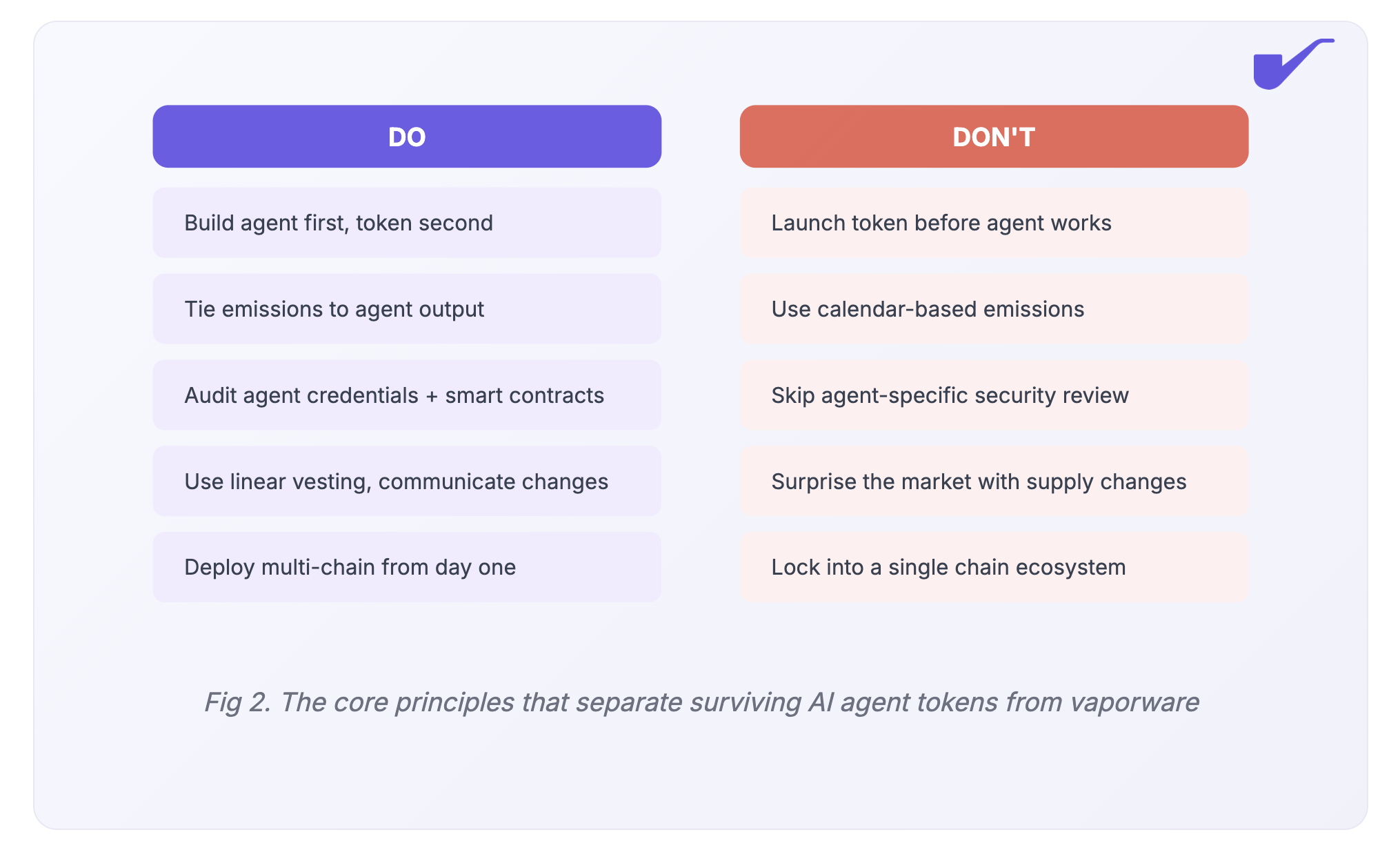
1. Build the agent before the token. Every AI token that held value through 2025 had a working agent generating on-chain activity before TGE. Narrative-first launches with no functional agent lost 90%+ within months.
2. Tie every emission to agent output. Calendar-based unlocks disconnected from usage have killed more AI tokens than bad code. The AI16Z supply expansion (40% overnight, 28% crash) is the clearest case study of what happens when tokenomics and utility are disconnected.
3. Audit the agent layer, not just the contracts. Only 29% of teams deploying agentic AI have adequate security readiness. Agentic systems introduce attack surfaces like credential hoarding, cascading multi-agent compromise, and prompt injection that standard smart contract audits were never designed to catch.
Choosing the Right Framework for Your AI Agent
The framework you build on determines your agent's capabilities and ceiling. ElizaOS is the leading open-source option, built in TypeScript with 90+ plugins covering Discord, X, Ethereum, Solana, Base, and BSC. Over 50,000 agents run on ElizaOS managing $20 billion+ in value across chains, with a modular architecture that lets you extend functionality without touching core code. For teams that want to skip code entirely, Virtuals Protocol on Base offers no-code agent building and tokenization, with a $508 million market cap as of March 2026. Virtuals grew weekly transactions from under 5,000 to over 25,000 after integrating Coinbase's x402 payment standard. For multi-agent DeFi coordination, Autonolas (OLAS) handles complex cross-chain workflows. Bittensor runs 128 specialized subnets where miners stake tokens and compete to provide compute, storage, and ML inference. Pick your framework based on what your agent does, not which ecosystem has the most hype.

Tokenomics Patterns That Actually Work for AI Agents
Standard token models break down for AI agent protocols because the token needs to power actual agent activity, not just governance or speculation. The strongest projects in 2026 tie every emission to measurable agent output. Akash Network burns $0.85 in AKT for every $1 of compute consumed, creating deflationary pressure that scales with usage. Bittensor rewards miners based on compute quality, not volume. Virtuals Protocol lets holders convert to xVirtual for staking rewards correlated with agent transaction fees. The pattern that keeps failing: arbitrary emission schedules disconnected from utility. If your token unlocks on a calendar and your agent has no users, you are just diluting holders. Design the loop so more agent activity means more token demand, whether through compute staking, inference burn, or fee distribution. We wrote a deeper breakdown of how to source and structure protocol liquidity in 2026 that covers the mechanics of sustaining these token flows post-launch. The cautionary tale is the AI16Z to ELIZAOS migration, where a 1:6 swap inflated supply from 6.6 billion to 11 billion tokens overnight and the token crashed 28% within 24 hours. Even technically sound upgrades get punished when supply changes surprise the market.
The Dos: What Separates Surviving Projects
Start with a working agent before you launch a token. From our work with AI-integrated protocols, the single clearest predictor of survival is whether the agent was generating real on-chain activity before the TGE. The projects that survived into 2026 built functional prototypes first, then introduced a token to coordinate incentives. GOAT evolved from a meme into an autonomous capital coordination layer, with its agent controlling an on-chain treasury through DAO governance. Virtuals proved utility by growing its agent ecosystem before layering in the x402 payment standard to connect agents to real transaction flow. Ship your agent on testnet, demonstrate measurable output (transactions processed, yield generated, tasks completed), and only then design the token around validated behavior. Use linear vesting over cliff-based unlocks, communicate supply changes at least 30 days before they happen, and keep team allocation at 15 to 20 percent on a four-year vest. Build for multi-chain from day one using Chainlink CCIP or LayerZero OFT rather than locking into a single ecosystem.
The Don'ts: How Most AI Agent Tokens Die
The top killer is launching a token around an agent that does not exist yet. Research from Composio shows that 95% of enterprise AI pilots fail to deliver expected returns, and the ratio is worse in crypto where the bar for "launching" is a tweet and a bonding curve. Teams get stuck in pilot purgatory: impressive demos that break on edge cases and architectures that cannot handle concurrent users. The second failure mode is ignoring agent-specific security. Standard audits cover on-chain logic but miss agentic attack surfaces: credential hoarding where agents accumulate API keys as single points of failure, cascading compromise where one breached orchestrator exposes every downstream agent, and prompt injection that manipulates decision-making to trigger unauthorized operations. Only 29% of organizations deploying agentic AI report security readiness. The third failure is treating the token as the product. AI agent tokens that lost 90%+ of their value in 2025 almost universally launched narrative-first with no functional agent behind the token.
5 Steps to Build and Launch an AI Agent Token
Step 1: Build and validate the agent. Choose your framework (ElizaOS for custom logic, Virtuals for no-code, Olas for DeFi automation) and ship a working agent on testnet. Run it for at least 4 to 8 weeks and measure real output: transactions processed, yield generated, tasks completed, or users served. If your agent cannot demonstrate measurable on-chain value without a token, it will not generate value with one.
Step 2: Design tokenomics around agent activity. Map every token emission to a specific agent behavior. Decide whether your model is compute-staking (users stake to deploy or access agents), inference burn (tokens destroyed per agent action), or fee distribution (holders earn from agent revenue). Model supply dynamics against realistic adoption curves before writing any contracts. Keep team allocation at 15 to 20 percent on a four-year vest with a one-year cliff.
Step 3: Audit both the contracts and the agent layer. A smart contract audit alone is not sufficient for an AI agent token. You need coverage across four surfaces: on-chain logic, agent credential management, inter-agent communication, and the framework supply chain. Budget $10,000 to $60,000 for a thorough review. Run AI-powered scanning tools during development, then bring in human auditors for the formal review before deployment.
Step 4: Launch the token with seeded liquidity. Deploy via Pump.fun (Solana), Virtuals (Base), or a structured launchpad depending on your chain and audience. Seed liquidity pools on at least two DEXs with enough depth to absorb early sell pressure. Communicate your vesting schedule, supply mechanics, and agent performance data publicly before TGE. No surprises.
Step 5: Scale the agent, not the narrative. Post-launch, your roadmap should focus on expanding agent capabilities, onboarding integrations, and growing real usage. Publish agent performance dashboards showing transactions, revenue, and compute consumption. The token price will follow agent adoption. If your post-TGE plan is "more marketing," you have already lost.
Security for AI Agent Tokens: What Standard Audits Miss
This is the area where we see the most dangerous blind spots. AI agent tokens introduce attack surfaces that traditional audits were never designed to catch, and most teams do not realize this until after something breaks. Barracuda Security found 43+ agent framework components with embedded exploits affecting thousands of developers. The risks: credential hoarding, where agents store API keys in config files and a single compromise opens weeks of unauthorized access; message bus vulnerabilities, where agent-to-agent APIs lack encryption, enabling interception; and prompt injection, where malicious inputs break guardrails and trigger expensive on-chain operations. The emerging standard is Zero Trust for Agents (ZTAA): no permanent access tokens, continuous credential rotation, and automated circuit breakers that halt activity when behavior deviates from expected patterns. In our experience, the teams that avoid catastrophic exploits are the ones that treat their agent's credential layer with the same rigor as their smart contract layer. A proper review for an AI agent token needs to cover four surfaces: smart contract logic, agent credential management, inter-agent communication channels, and the framework supply chain. AI-powered audit tools can scan for vulnerabilities during development, but they complement rather than replace a thorough human audit. If you are evaluating auditors for an AI agent protocol, our guide on how to choose the right auditor in 2026 covers what to look for beyond just smart contract coverage.
Compute Infrastructure and the Cost of Running Agents On-Chain
One thing we tell every AI agent team we work with: budget your compute costs before you finalize your tokenomics, because underestimating inference expenses is the fastest way to create a token that bleeds treasury on day one. Your agent needs compute to run, and how you source it shapes your cost structure and decentralization story. Render Network runs 5,600 GPU nodes and has burned over 1 million RENDER tokens through burn-mint equilibrium. Akash targets the $100 billion AWS AI market with 80% cost reduction and plans to acquire 7,200 NVIDIA GB200 GPUs through Starcluster. Budget $500 to $5,000 monthly depending on inference volume. Clustered RTX 4090s cut inference costs 75% versus H100s for batch processing. Build with compute flexibility: decentralized networks as the primary layer, centralized redundancy so an outage does not kill your agent.
Conclusion
Launching an AI agentic Web3 protocol is a large task but exceptionally rewarding thing to do in 2026. If you follow what we outlined in this article, there's a great chance your project can succeed and sustain itself long term into the agentic future of Web3.
Building an AI agent protocol and need your smart contracts and agent systems secured before launch? Talk to the Sherlock team and we will scope a security program that covers both your on-chain logic and your agentic infrastructure.
Frequently Asked Questions
What frameworks can you use to build an AI agent token in 2026?
ElizaOS leads with 90+ plugins and 50,000+ deployed agents on Ethereum, Solana, Base, and BSC. Virtuals Protocol offers no-code agent building on Base with Coinbase x402 integration. Autonolas handles multi-agent DeFi automation, and Bittensor provides decentralized ML compute across 128 subnets.
What are the biggest mistakes when launching an AI agent token?
Launching without a working agent, surprise supply inflation (the AI16Z 40% expansion crashed the token 28%), and ignoring agent-specific security risks like credential hoarding and prompt injection. Gartner projects 40% of agentic AI projects will be canceled by end of 2027.
How much does it cost to build and launch an AI agent token?
A minimal launch using ElizaOS and Pump.fun costs under $2,000. A production-grade launch with custom agent logic, audit, compute, and legal runs $30,000 to $100,000. Ongoing compute on Akash or Render costs $500 to $5,000 per month.
How do you design tokenomics for an AI agent protocol?
Tie every emission to measurable agent output. Use compute-staking, inference-based burn mechanisms, or fee distribution models. Akash burns $0.85 AKT per $1 of compute consumed. Avoid calendar-based unlocks disconnected from agent usage.
What security risks are unique to AI agent tokens?
Credential hoarding (agents storing API keys as single points of failure), multi-agent cascading compromise (one breached orchestrator exposing downstream agents), prompt injection attacks, and framework supply chain exploits (43+ components found with embedded vulnerabilities).
Which blockchain is best for AI agent tokens in 2026?
Solana for consumer-facing agents needing high throughput and low fees. Base for Coinbase distribution and x402 payments. Ethereum L2s for institutional DeFi composability. Most production projects deploy cross-chain using Chainlink CCIP or LayerZero.
.png)
.png)
.png)