Ripple x Sherlock: Pressure-Testing the XRPL Roadmap

Ripple x Sherlock: Pressure-Testing the XRPL Roadmap
Ripple is one of the most established names in digital assets and one of the leading contributors to the XRPL ecosystem. XRPL itself is one of the longest-running blockchain networks in production, with protocol changes activated through an amendment process that requires new functionality to be reviewed before it becomes part of live ledger behavior.
As several areas of upcoming XRPL functionality moved through that pipeline, Ripple worked with Sherlock to bring competitive external security review to the roadmap. The engagement gave independent researchers two weeks to pressure-test the new surface before broader adoption.
This was Sherlock’s first engagement in collaboration with Ripple, and the structure was built around the shape of the work: multiple feature areas, multiple risk profiles, and a need for coverage across the full amendment surface.
The Mandate
Ripple engaged Sherlock to bring competitive external review to five upcoming areas of XRPL functionality before broader adoption.
The objective shaped the entire engagement: drive deep security coverage across the scope, surface the most serious issues, and report them for remediation while the features were still in review.
Five Surfaces, One Ledger
XRPL evolves through amendments, and this stretch of the roadmap was broad.
The contest covered five upcoming areas of functionality:
Batch Transactions
Permission Delegation
MPT DEX
Confidential Transfers for MPT
Sponsored Fees and Reserves
Together, those areas touched transaction execution, delegated authority, market structure, token privacy, fee sponsorship, and reserve logic.
Rewarding the Whole Surface
A flat reward pool, the usual shape of an audit contest, can pull researchers toward the most familiar or obviously risky corner of the scope. Across distinct feature areas, that can leave gaps.
Sherlock structured the engagement to reward coverage across the full release surface.
Each feature area unlocked part of the pool independently, based on the highest valid severity found in that area:
Low: $1,800
Medium: $13,800
High: $43,800
Critical: $103,800
Only the highest valid severity in each feature determined that feature’s unlock amount. After the total reward pool was unlocked, it was distributed across every valid finding using severity-based weights, from 0.5 for a Low to 10 for a Critical.
The pool unlocked one way and divided another. Breadth and depth were priced in on purpose.
Findings Across the Board
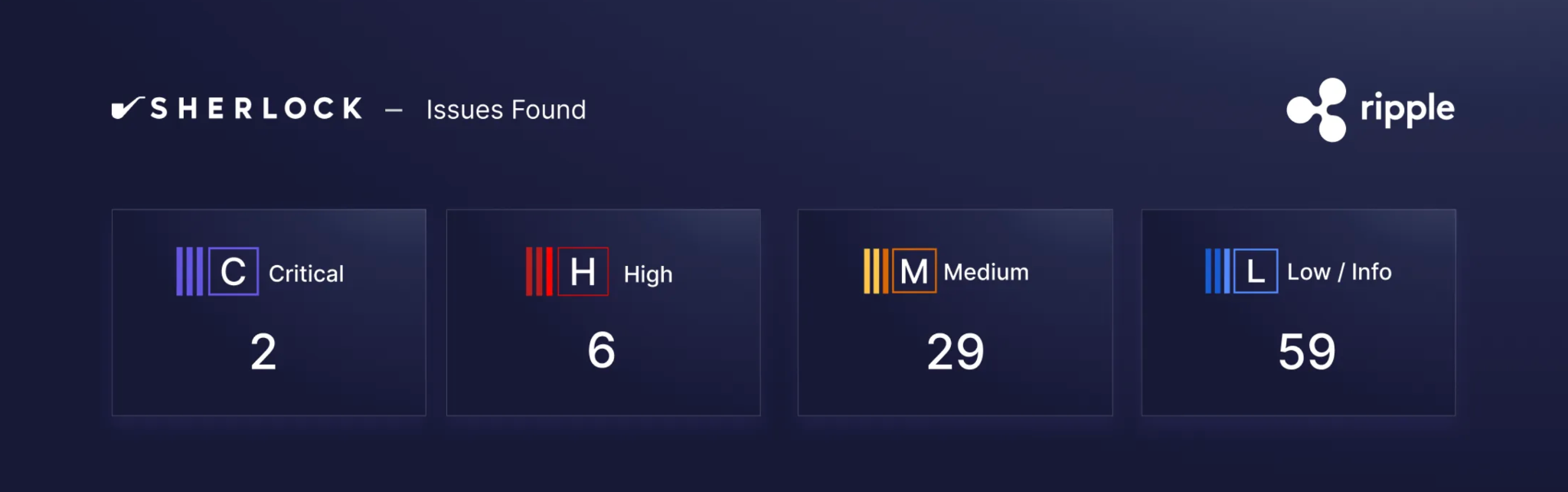
Over two weeks, researchers surfaced serious issues across the scope:
2 Criticals
6 Highs
29 Mediums
59 Lows
Valid findings landed in every one of the five feature areas, and a total of $309,000 in rewards was unlocked.
That spread showed the structure working as intended: researcher attention reached every scoped area of the release surface.
Where the Pool Unlocked
Each feature area unlocked based on its highest valid severity:
Batch Transactions: Critical, $103,800 unlocked. Signatures in the new signing scheme were not bound to a unique batch or the account being signed for.
Confidential Transfers for MPT: Critical, $103,800 unlocked. A soundness issue affected the zero-knowledge range-proof system behind confidential balances.
MPT DEX: High, $43,800 unlocked. The densest area of findings, including bypassed transfer-fee burns and order-book data that overstated executable liquidity.
Permission Delegation: High, $43,800 unlocked. Weak validation of delegation targets could reach protocol-managed accounts.
Sponsored Fees and Reserves: Medium, $13,800 unlocked. Accounting edge cases affected who pays fees and reserves.
Two Findings, Two Disciplines
The work ranged from deep cryptography to transaction authorization design. Both findings below were reported to Ripple for remediation ahead of broader adoption.
Critical Finding: A soundness break in Confidential Transfers
Confidential balances are proven valid with zero-knowledge range proofs, and that soundness depends on two cryptographic generators being independent. In the reported issue, both were derived from the same label, making them aliased rather than independent.
That broke a core assumption behind the proof system. A holder could forge a proof for an out-of-range value, credit themselves with a balance no deposit backed, and redeem it against the shared pool backing confidential holders of the token. In the reported case, a true balance of ten could redeem ten thousand, leaving honest holders underbacked.
The fix derives the generators under distinct tags, restoring the independence required for soundness.
High Finding: Cross-account signature replay in Batch
Batch Transactions allow inner transactions from several accounts, each authorized by a signer. But in the multi-signature path, the signature was not bound to the account being signed for.
That meant a signature gathered for one account was identical to one gathered for another. In cases where accounts share a signer list, such as treasuries or shared custody setups, an attacker could replay signatures to authorize a fund-draining transaction the signers never approved.
The fix binds the signing-for account into the signature through a new amendment.
The Value of Reviewing Early
XRPL activates new functionality through amendments, which makes pre-activation review the moment where security work has the most leverage. Ripple brought the scoped roadmap to Sherlock early enough for a large field of Web3 security researchers to attack it while fixes could still move through normal engineering review.
More eyes. More attack paths. Earlier fixes.
That was the advantage of the contest. Ripple brought the protocol context, Sherlock shaped the incentives, and researchers brought high-volume adversarial pressure across the scoped functionality. The result was a clearer view of where risk actually sat before activation, backed by real findings from researchers competing to break the assumptions behind the new surface.
The Outcome

For Ripple, the engagement turned a broad upcoming XRPL release surface into a prioritized remediation path before broader adoption. Valid findings landed across every scoped area, with $309,000 in rewards unlocked for the researchers who found them.
For Sherlock, it was a strong first collaboration with Ripple and a clear example of how custom contest design can support complex protocol work. We’re grateful to the Ripple team for trusting Sherlock with the review, and to the researchers who brought serious attention to the scope.
This was the first Sherlock x Ripple engagement. We’re excited for what comes next.