Smart Contract Audit Pricing: A Market Reference for 2026
Smart contract audit costs range from $5K to $250K+ in 2026. This research guide breaks down pricing by protocol type, firm tier, and chain language.

Published by Sherlock | February 2026
How much does a smart contract audit cost? In 2026, prices range from $5,000 for a simple token contract to over $250,000 for enterprise-grade multi-chain systems — and the final number depends on what you're building, which chain you're on, which firm or platform you choose, and how fast you need results.
Smart contract audits do not have a fixed price. The final cost depends on what a protocol is building, which chain it runs on, which firm or platform it chooses, and how quickly it needs results. Quotes for functionally similar scopes can range from $15,000 to $150,000 depending on those variables. This document compiles observed market pricing as of early 2026 to give protocol teams, investors, and researchers an accurate baseline before entering procurement.
For a broader introduction to how auditing works as a practice, see Sherlock's complete guide to smart contract auditing.
The Pricing Landscape
The audit market spans roughly $5,000 to $250,000 per engagement, with most DeFi protocol audits landing between $25,000 and $100,000. That spread reflects genuine complexity differences. A lending protocol with a novel interest rate model, multiple oracle integrations, and a cross-chain component is not arbitrarily more expensive than an ERC-20 token. It represents a fundamentally larger attack surface that requires more time, more specialized expertise, and in many cases, reviewers with domain-specific knowledge of the relevant VM and language.

The figures above reflect quotes observed across the market from 2025 through early 2026. They do not include re-audit rounds after remediation, which typically add $5,000 to $20,000 per pass. Almost every protocol requires at least one remediation review after initial findings, and that cost should be budgeted at the outset rather than treated as a surprise.
What Drives the Number
Four variables account for most of the variance in audit pricing.
Codebase size is the primary driver. Most firms and platforms price by non-comment source lines of code (nSLOC). Sherlock's published audit timeline guidelines put approximately 500 nSLOC at a 3-day contest window and 6,000 nSLOC at 38 days, with cost scaling in proportion. Scope that looks small on the surface often expands once integration dependencies are counted.
Chain and programming language carry significant premium differentials. Solidity has the most competitive auditor market globally, which keeps base prices anchored. Rust-based Solana programs carry a 25 to 40 percent premium because the pool of qualified reviewers is substantially smaller. Cairo (StarkNet) and Move (Sui, Aptos) sit at 30 to 45 percent above EVM equivalents. ZK circuit audits, which require deep cryptographic expertise across tools like circom, Halo2, and Plonky2, routinely run 80 to 120 percent above EVM baseline. This is an auditor supply problem as much as a technical one.
Urgency adds 20 to 40 percent to base fees. A team that needs results in one week instead of four is asking a firm to redirect senior capacity, compress review windows, and accept coordination overhead. The market prices that friction directly.
Firm tier matters in ways that extend beyond technical quality. An audit certificate from a top-tier firm carries documented weight with institutional investors, major exchanges, and sophisticated counterparties during fundraising and listing reviews. That reputational signal has economic value independent of the depth of the review itself.

The Stakes Behind the Numbers
Audit pricing only makes sense in context. The market for security review exists because the cost of inadequate review has proven catastrophic across multiple cycles.
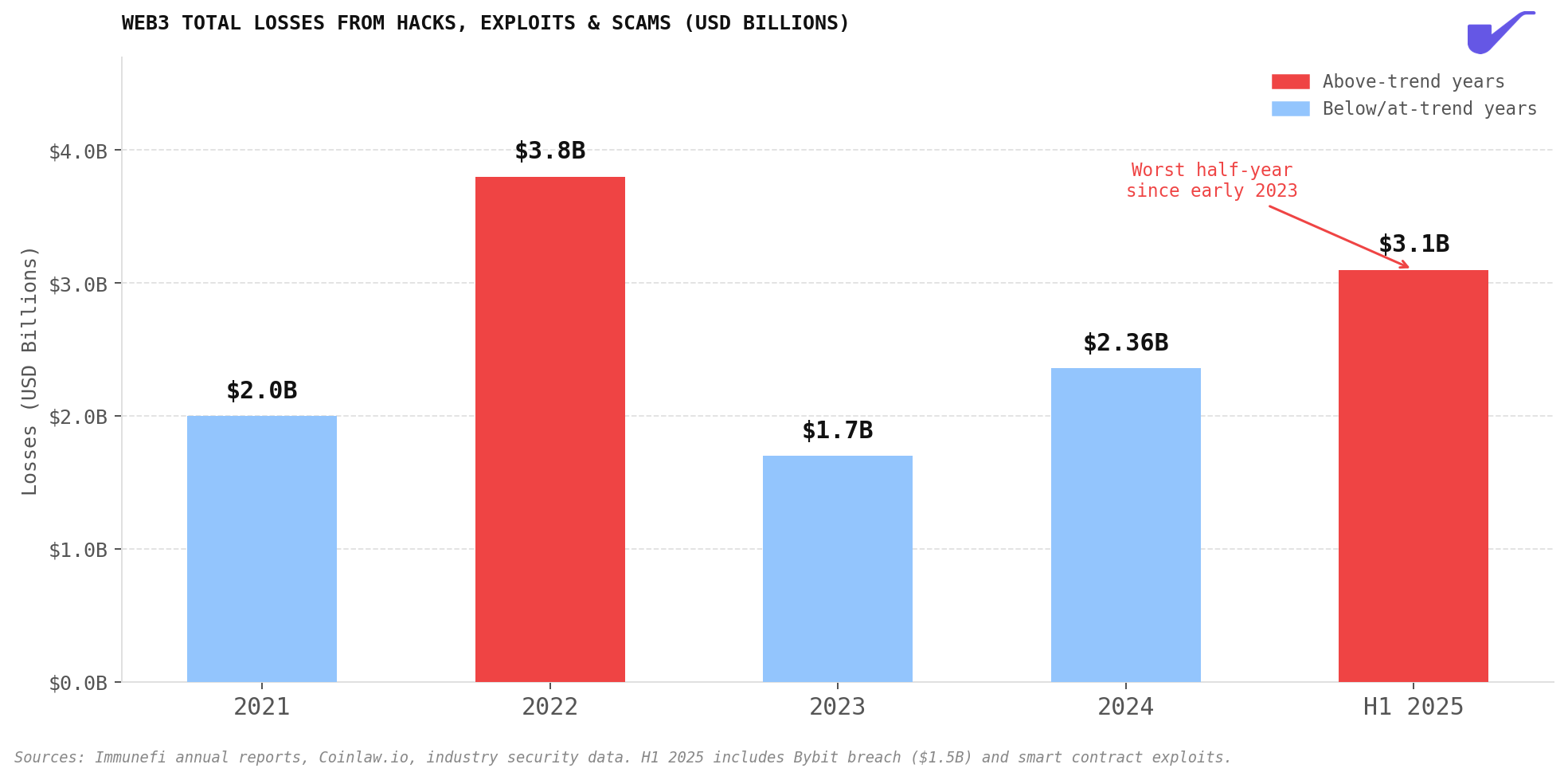
H1 2025 totaled roughly $3.1 billion in losses across the Web3 ecosystem, the worst six-month period since early 2023. Smart contract bugs specifically accounted for approximately $263 million of that figure. Access control exploits drove the largest share at $1.63 billion, a category that competent audits and operational security programs are both designed to address. Data on Web3 loss patterns is tracked in detail by Immunefi's annual security reports, which provide the most comprehensive public dataset on this subject.
The average loss per smart contract exploit across the past four years has been approximately $1.9 million. Against that number, a $70,000 audit for a mid-complexity DeFi protocol is not an expensive line item. It is a cost that scales with the risk it is being asked to reduce. For additional context on how the 2025 threat landscape shifted security program design, ee Sherlock's Web3 security review and 2026 projections.
Audit Models: How Protocols Approach Coverage
Three structural models dominate the market. Traditional firm-led audits assign a dedicated team to a codebase and deliver a named report, which is what most investors and exchanges recognize as a credential. Contest-based platforms deploy 100 to 500 independent researchers simultaneously against the same scope, often surfacing issues that smaller dedicated teams miss through sheer volume of parallel coverage. Bug bounty programs operate post-launch and create ongoing incentives for external researchers to find and report vulnerabilities responsibly. Immunefi is the largest bug bounty platform in Web3 and has paid out over $110 million in total bounties across more than 400 programs.
Most established protocols now combine all three: a firm audit before launch, a contest for breadth, and a standing bounty program afterward. Total annual security budgets for protocols with meaningful TVL routinely run $150,000 to $500,000. Blue-chip protocols often spend considerably more when monitoring, continuous re-audits, and large bounty pools are included.
Sherlock’s collaborative smart contract audits, delivered by Sherlock and Blackthorn researchers, are a primary option for teams that want deep, hands-on security work with clear ownership from start to finish. The collaborative audit model is documented in full for teams evaluating which approach fits their scope and timeline.
Summary
A realistic pre-launch budget for a mid-complexity DeFi protocol in 2026 is $60,000 to $120,000, inclusive of the initial audit and at least one remediation review. Protocols on Rust, Cairo, or ZK stacks should apply a 30 to 120 percent premium over EVM-equivalent estimates depending on language and scope complexity. Urgency premiums of 20 to 40 percent apply to engagements with compressed timelines.
Security spend is most accurately treated as a function of TVL exposure and protocol risk surface. The historical record across every market cycle makes the calculus consistent: the cost of review is small relative to the cost of a single critical failure. The Sherlock audit pricing and timeline documentation provides specific guidance on scope sizing and contest duration for teams in active procurement.
FAQ Smart Contract Audit Costs:
How much does a smart contract audit cost in 2026?
Most audits land between $5,000 and $250,000 depending on protocol complexity. A simple ERC-20 token typically costs $5,000 to $20,000. A mid-complexity DeFi protocol runs $40,000 to $100,000. Enterprise multi-chain systems routinely exceed $150,000. Re-audit rounds after remediation add $5,000 to $20,000 per pass and should be budgeted upfront.
What factors affect smart contract audit pricing?
Four variables drive most of the variance: codebase size (measured in nSLOC), chain and programming language, firm tier and reputation, and timeline urgency. Rust and Solana programs carry a 25 to 40 percent premium over Solidity equivalents due to auditor scarcity. Rush timelines add 20 to 40 percent on top of base fees.
How long does a smart contract audit take?
Duration scales directly with codebase size. A 500 nSLOC scope takes roughly 3 days on a contest model. A 3,000 nSLOC scope takes around 18 days. A 6,000 nSLOC scope runs approximately 38 days. Traditional firm audits follow similar timelines but vary by team availability. Factor in additional time for remediation and fix verification before treating the audit as complete.
What is the difference between a smart contract audit and a bug bounty?
An audit is a structured, time-boxed review conducted before launch. A bug bounty is an ongoing post-launch program that pays external researchers per valid finding. They serve different purposes and most mature protocols run both. Immunefi is the largest bug bounty platform in Web3 and has paid out over $110 million in total bounties. An audit does not replace a bounty program, and a bounty program is not a substitute for a pre-launch audit.
Is a smart contract audit worth the cost?
The average loss per smart contract exploit over the past four years has been approximately $1.9 million. H1 2025 saw roughly $3.1 billion in total Web3 losses. Against those figures, a $70,000 audit for a mid-complexity DeFi protocol is not a large expense relative to the risk it reduces. Beyond loss prevention, audit reports carry weight with investors during fundraising, with exchanges during listing reviews, and with institutional counterparties evaluating integration risk.
.png)
.png)
.png)