How to Start a Web3 Company in 2026
Sherlock's practical guide to building a serious web3 company in 2026, from entity setup and fundraising to compliance, security, and go-to-market.
.png)
Sherlock Research · April 2026
The sequence of decisions that separates serious web3 companies from unserious ones, in the order founders actually face them.
$9.27 billion flowed into web3 in Q1 2026, but the gap between funded teams and teams that survive has never been wider. AI tooling has compressed the path from idea to testnet MVP into weeks. The companies that last are the ones that sequence their decisions correctly: validate a real wedge before raising, keep the team small, skip the token at launch, and treat legal structure and security as architecture rather than checkboxes. This guide covers each of those decisions in the order founders actually face them.
What Makes Building a Web3 Company Different
In web3, your product, capital formation, governance, distribution, and security posture are all entangled from the very beginning. The token design affects your fundraise, the fundraise affects your legal structure, the legal structure constrains your governance, and a single security failure at any layer can destroy the whole thing overnight. Your smart contracts are open source by default, which means anyone can fork your code in hours. But it also means other protocols can compose on top of yours, creating network effects that proprietary software cannot replicate. The teams that win are the ones that understand these dependencies early and design for them deliberately.
AI-assisted development (Claude Code, Cursor, Copilot) has compressed build speed dramatically. A focused two-person team can ship a testnet MVP in weeks. But AI compresses the easy parts of building. It does not remove the need for senior judgment in architecture, incentive design, legal structuring, or adversarial security thinking. Founders who treat AI as a way to skip those harder problems will build faster and fail faster in roughly equal measure.
Pick a Vertical Where You Have a Real Wedge
DeFi and core infrastructure captured roughly 75% of web3 venture funding in early 2025, and that ratio has held. AI agent infrastructure is the fastest-growing category: autonomous agents need wallets, payment rails (x402 protocol), and identity systems to transact on-chain, and Circle reports agents completed over 140 million payments totaling $43 million in nine months. This vertical favors technical founders who understand both ML infrastructure and on-chain primitives. Real-world asset tokenization is attracting institutional capital but involves long sales cycles and heavy regulatory overhead, favoring teams with financial services backgrounds. Stablecoin payments infrastructure is scaling fast but increasingly dominated by well-funded incumbents.
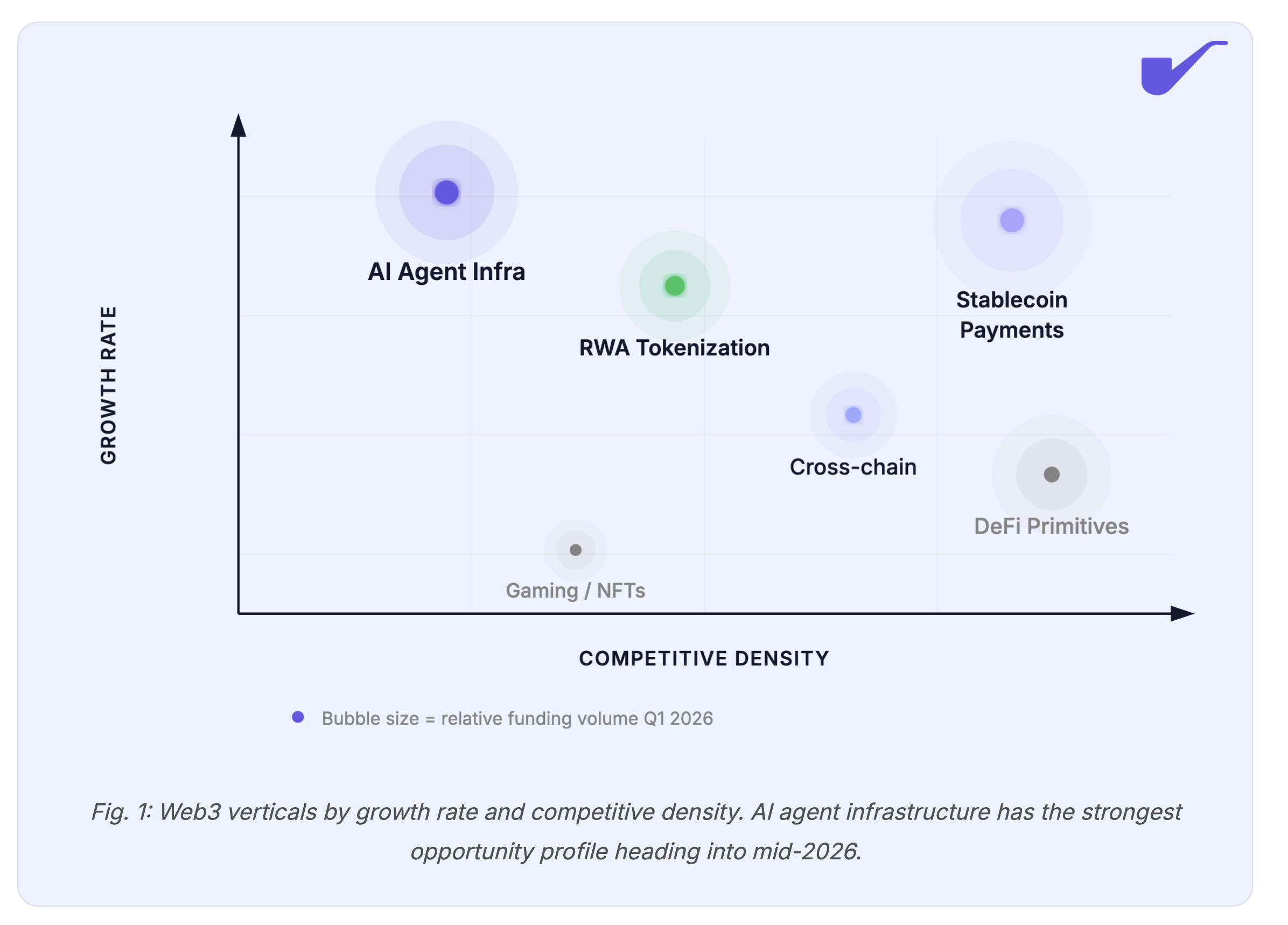
The honest question before committing: does your problem actually require a blockchain, or are you adding a token to a web2 product because that is where the funding is? Most products do not need a token at launch. Start with a capability that cannot be replicated off-chain.
Assemble a Team That Can Ship and Survive
The minimum viable team is smaller than most founders think. You need a smart contract engineer who understands Solidity (or Rust for Solana) deeply enough to review AI-generated code and make security-critical decisions. You need someone who understands tokenomics under adversarial conditions. And you need crypto-native legal counsel from day one. Most web3 founding teams are too engineering-heavy and too weak on distribution. A technically sound protocol can still die because nobody on the team understands how users, liquidity, and governance will actually form around the product. If your team cannot think clearly about how value flows through your system and how the first thousand users arrive, you have a technical project, not a company.
Set Up Your Entity Structure Early
Without a formal entity, a founding team is a general partnership with unlimited personal liability. The standard approach is a multi-entity structure with three components.
DevCoTeam, IP, equityDelaware C-corp / CaymanRaises capitalserviceagreementTokenCoToken, treasuryBVI / Switzerland / SingaporeIsolates token liabilitywhenreadyDAOGovernanceMarshall Islands / WyomingOptional at launchSeparate before your first fundraise, equity split, or hire.4-8 weeks · $15K-$50KFig. 1: The standard web3 multi-entity structure. DevCo holds the team and raises equity, TokenCo isolates token liability, DAO wrapper is added when governance is ready.
The DevCo is typically a Delaware C-corp or Cayman entity that houses the core team and raises equity. The TokenCo sits in a crypto-friendly jurisdiction (BVI offers 0% corporate tax and under-30-day incorporation; Marshall Islands provides DAO LLC structures; Switzerland and Singapore remain popular) and handles token issuance, distribution, and treasury. This separation is critical: if regulators reclassify the token, the core business is protected behind a separate liability boundary. An optional DAO wrapper is added when the protocol is ready for decentralization. Budget $15,000 to $50,000 for the full multi-entity setup over 4 to 8 weeks.
In practice, the most common failure modes are not about choosing the wrong jurisdiction. They are about timing and discipline. Founders raise equity before formally separating the DevCo from the TokenCo, which creates messy cap table entanglements that are expensive to unwind. They let early contributors work on an informal handshake without service agreements, which creates IP ownership disputes later. They commingle treasury control and token issuance authority in a single entity, which defeats the entire purpose of the multi-entity structure. Get the separation done before your first fundraise, your first equity split, or your first hire. Fixing it later costs multiples of what it costs to do it right now.
Choose a Chain and Build Before You Raise
Once your entity structure is in place, you have the legal foundation to actually build. Chain selection is a product decision, and the real question is straightforward: where can you access users, liquidity, integrations, and trust fastest? That is a user acquisition cost question, not a technology philosophy question. Base gives you Coinbase distribution and native USDC. Arbitrum has the deepest DeFi TVL and the most mature composability stack. Solana offers sub-second finality for trading, payments, and consumer applications. Each ecosystem has its own grant programs, developer communities, and integration surface area. Pick the one where your first thousand users already have balances and are actively transacting. Do not choose a chain based on grants or marketing partnerships alone, and be aware that chain-specific advantages shift quickly enough that the evergreen question (where are my users?) is more durable than any snapshot of chain features.
Developer tooling has matured to the point where execution speed is limited by decisions, not infrastructure. Foundry is the default for serious Solidity development: Rust-based, fast, with native fuzzing and property testing built in. Anchor remains the standard for Solana. Node infrastructure from QuickNode and Alchemy means you no longer run your own nodes. Layer AI code generation on top and the path from architecture to testnet deployment compresses further. Use that speed to your advantage: get a working MVP on testnet before you spend any time fundraising. The strongest signal you can send to investors in 2026 is a product that works, not a pitch deck with projections. Most founders should build before they raise. The ones who raise first and build second tend to over-hire, over-scope, and burn runway on decisions that should have been tested with a leaner version of the product.
Fundraising: What Actually Matters
With a testnet MVP in hand and a clean entity structure, fundraising becomes a different conversation. Seed rounds in 2026 range from $500,000 to $5 million, with active firms including Paradigm, a16z crypto, Pantera, and Dragonfly. Tether was the most active institutional investor in Q1 2026 with 7 deals. The bar has shifted substantially. Investors expect a working MVP, a token legal opinion from the TokenCo's jurisdiction, and a founding team with verifiable execution history (shipped products, open source contributions, previous protocol launches).
What kills fundraising conversations is worth naming directly. Weak founder-market fit, meaning a team that cannot articulate why they are the right people to solve this specific problem in this specific market. Vague token logic, where the token exists because "web3 companies have tokens" rather than because it solves a concrete incentive alignment or governance problem. Messy entity setup, where the cap table has informal agreements, the DevCo and TokenCo are not separated, or the equity structure does not reflect who actually built what. And infrastructure cosplay, where a product sounds like a critical protocol primitive but has no real wedge, no existing demand, and no clear path to adoption. Come prepared with a clean founders' agreement, complete cap table, KYC/AML documentation, token model with emission schedule and governance roadmap, and a 24-month financial model. Capital efficiency has become a proxy for founder quality. The meetings that close rounds are the ones with no surprises.
Regulatory Compliance: The Deadlines That Shape Every Decision
This section covers the regulatory pressure points that are actively shaping founder decisions in 2026. It is not legal advice. If your product touches custody, trading, lending, yield, or cross-border payments, you need qualified counsel assessing your specific exposure. What follows is the landscape as we understand it.
The EU's MiCA regulation requires Crypto-Asset Service Providers to obtain authorization by July 1, 2026. Unauthorized operators face penalties up to 12.5% of annual turnover, license revocation, and potential personal executive liability. MiCA covers exchanges, custodians, wallet providers, and custody handlers. Whether bridges and cross-chain relays fall under MiCA remains subject to regulatory interpretation, which is exactly the kind of ambiguity that requires counsel.
The U.S. GENIUS Act final rules take effect January 18, 2027, applying to federally insured stablecoin issuers. The requirements include 100% reserve backing in U.S. currency or short-dated Treasuries (under 93 days), a one-business-day redemption window, and monthly public disclosures. Issuers exceeding $10 billion in outstanding stablecoins must transition to the federal framework or cease issuance. The OCC published proposed rules on February 25, 2026.
The practical implication for founders: if you are operating in the EU, MiCA authorization can take 6 to 12 months, so the window to begin that process is closing. If you are issuing a stablecoin or token that could be classified as a security, obtain a legal opinion before launch. If your protocol touches custody, trading, lending, or yield in any jurisdiction, build KYC/AML infrastructure from day one. Legal and security shortcuts taken early are the ones that punish you the hardest later, because the cost of retrofitting compliance after enforcement action is not just financial. It can be existential.
Security: The Section That Should Be the Longest
In January 2026 alone, 25 security incidents cost the web3 ecosystem $350.7 million. Smart contract exploits are not theoretical risks. They are the single most common way that web3 companies with otherwise sound products lose everything. This section is deliberately the most detailed in this guide, because the security decisions you make during development will determine whether your protocol survives its first year.
The practical approach is layered, and the layers matter in sequence. During development, automated scanning with tools like Slither and Echidna catches a specific class of vulnerabilities: reentrancy, integer overflow, access control misconfigurations, and common Solidity pitfalls. These tools are fast and cheap to run. AI-assisted security scanners (Sherlock AI, CertiK's AI Auditor) add a second layer that can flag more complex patterns during active development. What automated tooling catches well is the stuff that follows known patterns. What it misses consistently is business logic errors, economic exploits, oracle manipulation, cross-contract interaction flaws, and anything that requires understanding what the protocol is supposed to do rather than just what the code does. That distinction matters enormously, because the most expensive exploits in web3 history have overwhelmingly been in the category of things that automated tools cannot catch.
This is why a professional web3 audit provider led by human reviewers remains essential before any mainnet deployment. Pricing: simple token $5K-$15K, standard DeFi $50K-$100K, complex systems $150K-$500K+. For mid-complexity DeFi protocols, budget $60K-$120K including post-audit remediation. Many protocols pair their audit with a competitive code contest to surface additional vulnerabilities through a wider set of eyes. The combination of automated scanning during development and human-led review before launch is the current best practice because each layer catches what the other misses.
After launch, a standing bug bounty program is your ongoing defense. The standard sizing approach: allocate 5% to 10% of your total funding raised toward bug bounties, pre-funding at 2 to 3 times your maximum critical severity payout. A protocol that raises $3 million and allocates 7% ($210,000) to bounties would pre-fund with $420,000 to $630,000 to cover potential critical payouts over the first 12 months. Post-launch exploit coverage has also become standard: if an audited contract is later exploited due to a missed vulnerability, the coverage policy pays out. This gives both your team and your investors a quantifiable safety net. The total cost of a serious security posture is not trivial, but it is a fraction of what a single exploit costs.
Go-to-Market: Distribution Through Integration
If your entity is clean, your product is audited, and your compliance is in order, the final question is how you get users. Web3 distribution works differently than web2 distribution, and most teams underestimate how differently. The strongest version of the argument is simple: web3 distribution comes from trust, proximity, and integration, not from visibility. You can have the best marketing in the ecosystem and still fail to grow if your protocol is not woven into the on-chain workflows that your target users already depend on.
The real accelerant is becoming part of someone else's on-chain workflow. If your protocol exposes composable interfaces that other protocols build on top of, you create a chain of incentives where other teams are motivated to integrate you, promote you to their users, and expand your reach. That kind of distribution compounds in a way that grants, content, and conference sponsorships do not. Ecosystem grants (Base, Solana, and Arbitrum all run active programs) provide early capital and credibility. Technical content and governance participation build reputation. But the protocols with the strongest growth curves in 2026 are the ones with the richest integration surfaces, where their value is embedded in other products rather than marketed alongside them.
Have your documentation, bug bounty, governance framework, and community channels ready before mainnet deployment. The first 90 days are critical. Treat this period as an active beta with founding team engagement: be available to early users, respond quickly to issues, and demonstrate the kind of technical credibility and responsiveness that earns long-term trust in a market where trust is the scarcest resource.

This guide will be updated as regulatory frameworks, funding conditions, and infrastructure tooling continue to evolve in 2026 and beyond.
If you are launching a protocol and want to talk through security infrastructure, from initial audit through post-launch coverage, get in touch with our team.
.png)
.png)
.png)